
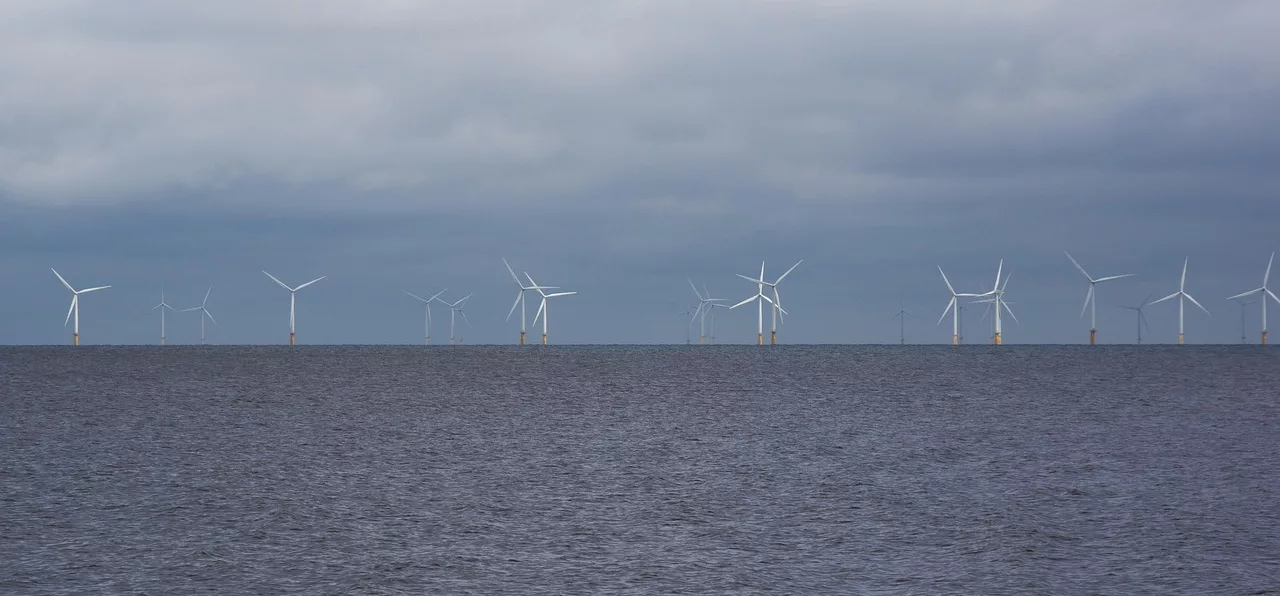
The Irish government will today sign up to a pledge to generate 100 gigawatts of energy through joint offshore wind projects with other countries around the North Sea.
If those projects come to fruition, it will mean a huge expansion of renewable energy generation for Europe.
Ireland’s Minister for Climate, Energy and the Environment Darragh O’Brien will sign up to the agreement at a meeting of energy ministers in Hamburg.
Together with Belgium, Denmark, France, Germany, Luxembourg, the Netherlands, Norway and the United Kingdom, Ireland will commit to working together on cross-border infrastructure including the development of new offshore wind farms in the North Sea.
“As a small, windy island at the edge of Europe, the offshore energy potential of Ireland is huge”, said Minister O’Brian ahead of his trip to Germany.
“Increasing our cross-border electricity interconnection will enhance European energy security, increase our economic competitiveness and critically reduce consumer prices. Today, I am pleased to sign the Hamburg Declaration, which will put in place tangible actions to enable greater interconnection in the North Seas, a key enabler of diversifying away from our reliance on fossil fuels.”
The group of countries aim to develop the North Sea region into Europe’s “green power plant” with the target of installing up to 300GW of offshore wind capacity by 2050.
Within five years, the first 20GW should be up and running, according to the Hamburg Declaration.
China generates more offshore wind energy than anywhere else in the world, producing around 43GW per year.
Ireland aims to reach 37GW – six times the country’s current electricity demand – by 2050.
It is hoped that more home-grown renewable energy will lead to lower bills.
But getting the projects off the ground will be complex and expensive.
Climate think tank, E3G, has suggested that some of the money could be raised by leveraging new cash designated for security and defence projects.
“North Seas wind infrastructure can enhance Europe’s security and industrial competitiveness if it is incorporated into the continent’s broader security approach and industrial strategy”, E3G argues.
“For instance, deploying new “dual-use” infrastructure and upgrading existing wind assets with security equipment can strengthen surveillance and protection capabilities. The construction of this dual-use infrastructure could be funded using domestic defence and security spending in line with NATO commitments.”
“The North Sea is a strategic key area for Europe’s energy and supply security”, said Germany’s energy minister, Katherina Reiche.
“By planning expansion, grids and industry together and implementing them across borders, we are creating clean and affordable energy, strengthening our industrial base and increasing Europe’s strategic sovereignty. Today’s investment pact provides reliable perspectives for the offshore sector, secures creation of value in Europe and brings future-proof jobs.”