
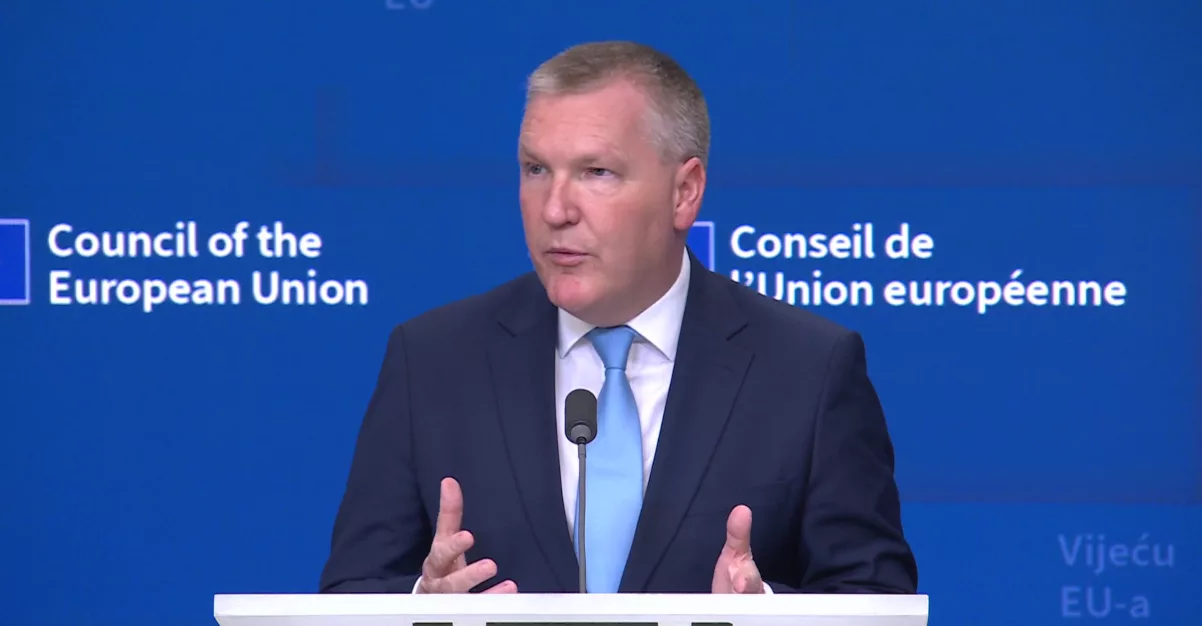
Ireland’s EU Commissioner, Michael McGrath, has unveiled proposals to radically shake up the way companies are founded and grow within the European Union.
The EU hopes the new company structure – branded ‘EU Inc’ – will be attractive to investors and cut red tape for business who want to trade across Europe.
Instead of navigating 27 different national company rules, Irish entrepreneurs and businesses would be able to operate with the same rules EU-wide.
EU Inc “has a simple objective: to reduce fragmentation and allow businesses to operate across the single market under one clear set of corporate rules”, said Commissioner McGrath.
The proposal is part of a broader push to try and move the EU a more attractive destination in the face of tough competition from the US and China.
Under the new plans, companies could be set up fully online within 48 hours with no minimum capital requirement and for a fee of €100 or less.
The European Commission estimates that 300,000 businesses – employing 1.6 million people – will register under EU Inc within 10 years.
Michael McGrath said that the current national legal systems “slows growth, increases costs and often discourages companies from scaling up across Europe”.
He believes the new regime will make Europe a more attractive place to retain talent and attract private sector investment by making it “much simpler to trade and grow across the borders”.
The EU says that it has tailored its designs after broad consultations.
But trade unions have raised concerns about labour rights.
“From Cork to Brussels: workers are flagging the risks of EU Inc”, the European Trade Union Confederation (ETUC) warned.
“Europe’s competitiveness challenges will not be solved by creating legal uncertainty or loopholes that undermine fundamental rights, collective bargaining and worker representation”, said ETUC General Secretary, Esther Lynch.
The European Commission insists that employment laws will not be undermined.
It also clarified that employees will pay taxes where they work and there will be no shopping around for headquartering in low-tax member states.
Industry has been more enthusiastic about the idea, but questions remain exactly how it will work especially in the case of legal disagreements.
According to the proposals, there could be “specialised judicial chambers or courts with the authority to handle disputes on EU Inc”, but this has not yet been fully decided.
The proposals will need to be scrutinised and approved by the European Parliament and EU ministers before EU Inc can become law.