

Ireland’s Finance Minister has promised to cut petrol prices to help ease pressure on drivers here caused by the war in the Middle East.
The Tánaiste and Minister for Finance Simon Harris TD said:
“The Government will take measures on Tuesday to reduce prices at the petrol pump, to support those most at risk of fuel poverty, and to help key sectors of the Irish economy that we depend on for our supply chains, including the haulage sector.”
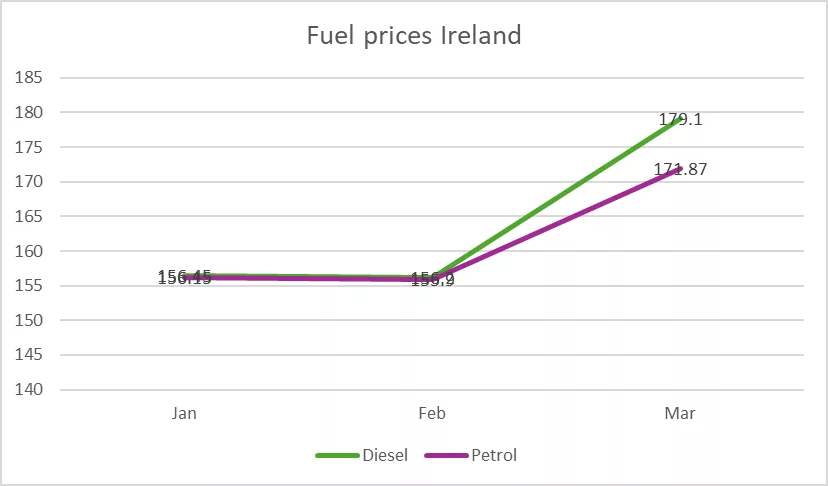
Diesel prices have increased from an average of €1.56 in February to €1.79 per litre and petrol is up from €1.56 to €1.72, according to data from Fuel Compare Ireland.
At some forecourts, diesel is selling for €2.20 per litre.
Over the weekend, President Trump issued Iran with a 48 hour warning to reopen the Strait of Hormuz to shipping or face a new round of attacks.
This morning, Iran threatened to widen its blockade to the entire Persian Gulf if US and Israeli airstrikes intensify.
“Threats by Iran to international shipping are unacceptable”, said Ireland’s Foreign Minister, Helen McEntee TD.
“Disruption to these vital routes are already having serious consequences for the global economy, felt most sharply by those least able to bear them.
European countries including Ireland insist that there is no oil shortage here. But the war is forcing prices up.
The Irish Farmers Association (IFA) said that agriculture was being particularly badly squeezed.
“Apart from the extra direct cost for farmers, farm contractors who do a lot of work on farms are experiencing significant cost increases,” IFA President Francie Gorman warned.
“Ahead of the Government announcement on Tuesday, we have written to the Minister for Finance requesting that he suspends the carbon tax on marked Gas Oil (Green Diesel and Kerosene). Government tax on green diesel is circa 22 cents per litre, of which 17c is carbon tax.”
“The only way the Government can make a significant difference to taxation on green diesel is to address carbon tax. There is no alternative fuel source for agricultural vehicles, so the tax cannot achieve its objective,” he said.
Francie Gorman said fertiliser prices are also surging as a result of the war.
“The EU fertiliser market has been disrupted as a sizeable amount of global fertiliser travels through the Strait of Hormuz. It’s imperative that our Minister for Agriculture pushes the EU Commission for the immediate suspension of CBAM [Carbon Border Adjustment Mechanism] tariffs on fertiliser,” he said.
Simon Harris said:
“The hit to oil supplies is of the order 20 million barrels per day – making it the largest ever shock to the global oil market.
“At this point, there is no clarity regarding the depth and duration of the conflict – this means there is considerable uncertainty regarding the economic fallout from the shock to oil supplies.
“If the conflict continues for a prolonged period, the impact on the global economy will be real – Ireland could not be immune from such an outcome.
“It is important to stress that we, in Ireland, are approaching this global economic challenge from a position of relative strength – we are running a significant budgetary surplus which gives us the fiscal capacity to respond.”
Meanwhile the International Energy Association (IEA) said its member countries has exceeded its pledge to release a record 400 million barrels of oi from strategic reserves.
According to the IEA, Ireland has put forward 1.7 million barrels from public stocks, more than the 1.6 million it pledged earlier this month.