
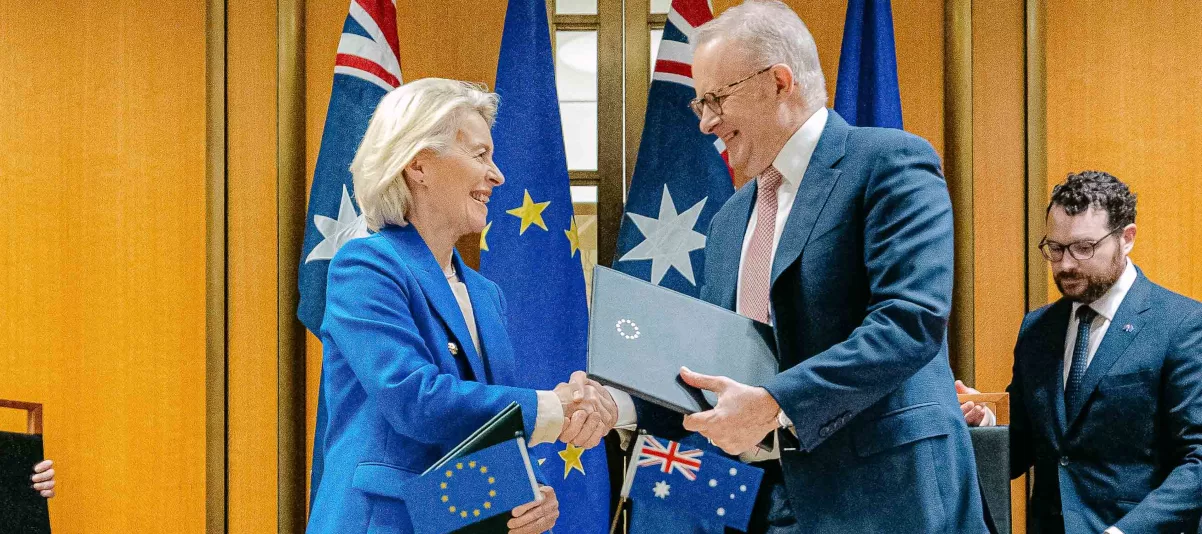
The European Commission has agreed to a trade deal with Australia which it says will cut tariffs for EU exporters by €1 billion.
The deal will see 99 percent of tariffs removed between the EU and Australia.
But some export restrictions will remain on some agricultural products to ensure Europe is not flooded with cheap Australian meat.
Ireland’s Minister for Foreign Affairs and Trade, Helen McEntee TD, welcomed the announcement.
“The Australian market is an attractive option for Irish exports and this trade deal will deliver areas of tariff reduction that will benefit Irish industry across a wide range of sectors, while also opening the Australian services market to the EU.”
“More than ever, in the face of unprecedented global economic uncertainty, it is important for Ireland and the EU to diversify our markets with new, reliable global partners. This trade deal represents a great opportunity for Irish firms to do just that”, she said.
The deal will need to be approved by the European Parliament, Council of the European Union and the Australian parliament.
The European Commission said it was an “ambitious and balanced” agreement that will lead to a big increase in trade.
It estimates trade in dairy and cars will increase by close to 50 percent. The European chemical industry will see exports increase by one-fifth, according to EU data.
Imports of Australian beef, lamb and sugar will be controlled by quotas.
Australia’s National Farmers’ Federation said it was disappointed not to gain “commercially meaningful agricultural market access” to Europe.
The European Commission says the deal also contains an extra safety net for European farmers.
“The agreement includes a bilateral safeguard mechanism allowing the EU to take measures to protect sensitive European products and their producers in the unlikely event of a surge in imports from Australia causing injury to the EU market”, the European Commission says.
This mechanism mirrors a similar clause in the EU’s deal with Mercosur countries. Irish farmers remain unconvinced that those protections will work effectively.
“The Commission has, as in every trade agreement, included robust safeguard measures for the agri-food sector, including limited tariff quotas, specific conditionalities for sensitive products and close monitoring of markets to act fast in the unlikely case of market disturbance”, said Christophe Hansen, European Commissioner for Agriculture and Food.
Separately to the trade agreement, the EU has also made a number of other deals with Australia including a security and defence agreement “enhancing cooperation on maritime security, cyber security, countering hybrid threats and foreign information manipulation and interference.”