
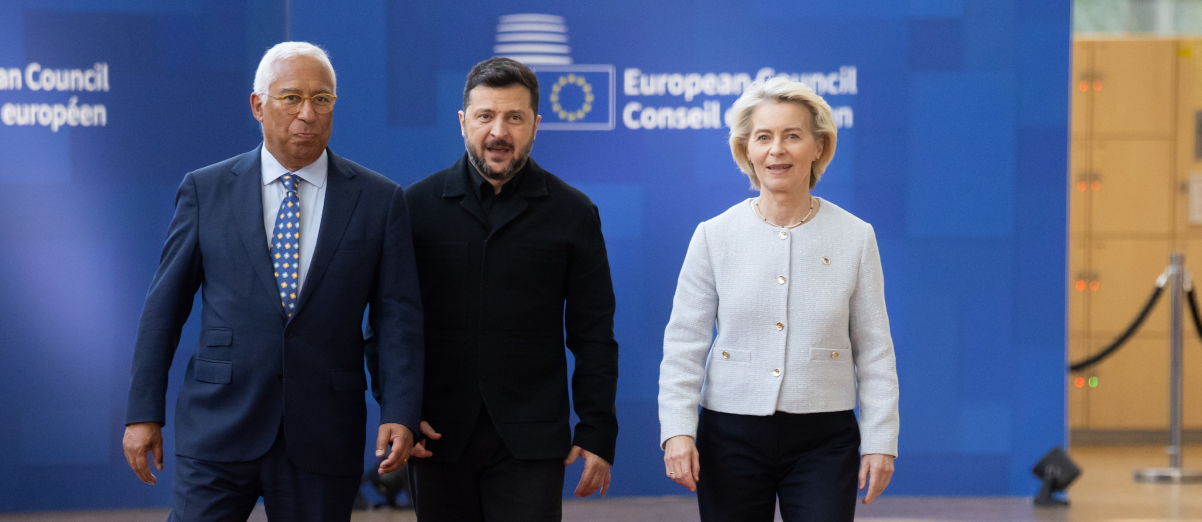
The President of the European Commission, Ursula von der Leyen, has announced plans for a €45 billion loan for Ukraine for next year after the Ukrainian government warned it would run out of money.
The EU has already signed off on a €90 billion loan which it is sending to Ukraine in tranches. That loan was supposed to keep the lights on in Ukraine until the end of 2027, but the Ukrainian government has warned that it will burn through the cash by next spring.
The EU loans are to pay for military equipment, but also to help run the government and pay for essential services like schools, hospitals and pensioners’ support.
The EU has calculated that Ukraine will be short of €70 billion in 2027 so the €45 billion proposed only covers about two-thirds of what it needs.
Von der Leyen said the rest should be donated by other partners like Norway, Canada and the UK.
The amount of money involved is significant. Von der Leyen said this morning that it was important that Europe strengthens Ukraine’s hand as much as possible.
“We think this is the best way to give Ukraine a strong hand at the negotiation table,” she said.
“The budget support will keep essential civilian services running, it will keep schools and hospitals operating. And the military support will give Ukraine the means to defend itself. The loan will also ensure that Ukraine will stay the course on reforms. And at the same time, the loan will contribute to a further integration of the Ukrainian and European defence industry. Most importantly, this support will give Ukraine the predictability it needs,” she added.
Like the €90 billion loan, the new €45 billion loan will be split in two parts: €20 billion for essential services and €25 billion for military needs.
The announcement comes as the momentum towards peace talks picks up a pace.
US negotiators met both the Russian and Ukrainian sides last week. According to President Zelenskyy, Europe was also at the table for the first time at talks earlier this week.
On Friday, EU leaders decided that Europe should be represented by a team made up of negotiators from the E5 (France, Britain, Italy, Germany and Poland) and an official from the European Council, the European Commission and NATO.
The EU’s foreign affairs chief, Kaja Kallas, was not selected to be part of that group.
Tomorrow, several key leaders including Andy Burnham, Friedrich Merz and Emmanual Macron will meet in Berlin. There will also be a meeting of the Coalition of the Willing which the Taoiseach and von der Leyen are expected to attend.
At the same time, on the other side of the world, Trump, Putin and Xi are due to meet.
European diplomats remain sceptical as to whether Russia is ready for peace with attacks in Ukraine continuing.