
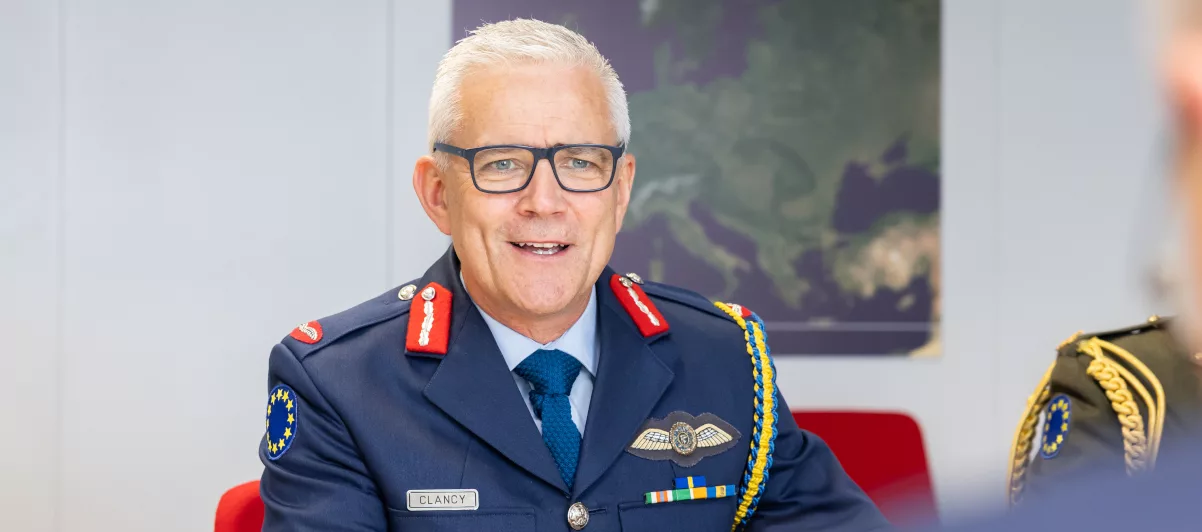
The chair of the EU’s highest military body, General Seán Clancy, has warned that Europe is facing multiple threats and must be prepared.
Previously Chief of Staff of the Irish Defence Forces, General Clancy has been chair of the European Union Military Committee (EUMC) since June last year.
His job is to work with Europe’s most senior military generals in each member state and advise the EU’s foreign affairs chief, Kaja Kallas on security and defence matters.
Under the EU’s ReArm Europe plan, the European Commission has put together up to €800 billion of funding in loans and grants to beef up European defence.
Some of that is for military equipment and new technology, but it is also about improving roads and railways to allow armies to get around the continent quicker in case of attack.
Europe is also facing new threats from hybrid attacks online to disinformation, threats to undersea internet cables and the use of migrants and energy as leverage.
“For the last three decades Europe lived inside a very reassuring strategic story”, said General Clancy, speaking at the European Policy Centre in Brussels.
“War on the continent was unthinkable. Deterrence was stable. Industry could optimise for efficiency and security could be managed with moderate moderate risk.
That story is over.
Today Europe faces a very strategic environment that is harsher faster and far less forgiving,. Defence and security are no longer abstract debates. They’re operational realities”, he warned.
And the dangerous are multiple and all at once, he said.
“The defining feature of today’s security environment is not one single threat but simultaneity. Risks are not sequential; they are layered and interconnected.
Conventional deterrence, hybrid pressure, cyber activity, space dependence, industrial resilience, and societal preparedness are all in play at the same time.
This has profound implications for European defence.”
The 27 Chiefs of Defence of the EU’s member states that make up the European Union Military Committee meet regularly to discuss the latest threats.
But they need the go ahead from their political masters to really improve European defence.
The shift is that Europe can no longer afford to react to a crisis, instead “readiness has become systemic”, said General Clancy.
It “spans the whole spectrum of peace, crisis, and conflict, and it includes decision-making speed, command and control, logistics, stockpiles, and industrial capacity.”
For defence to work more effectively, deterrence is also key, he added.
“Deterrence is as much about factories and supply chains as it is about armour brigades and flight squadrons.”
Most EU member states are part of NATO. And although General Clancy insisted that the Americans are still on board, he also conceded that Europe has to take more responsibility for the continent.
“The core strategic reality is that Europe must now assume primary responsibility for its own conventional defence”, he said.
Ireland, Malta and Austria are not in NATO and have different neutral stances.
Even so, each has had to accept that in the face of new dangers, investment in security and defence is necessary.
“I speak on behalf of the sovereign military leadership of all member states”, said General Seán Clancy
“The EUMC’s role is not political advocacy; it is military realism. We advise on what is feasible, sustainable, and required to translate political intent into credible military effect. Our focus is relentlessly on readiness, coherence, and credibility.”
And on whether the EU can act together on defence, his view is:
“The decisive question is whether Europe can decide, command, and act together at speed, and whether political leaders are ready to own the consequences. Defence is ultimately about responsibility.”