
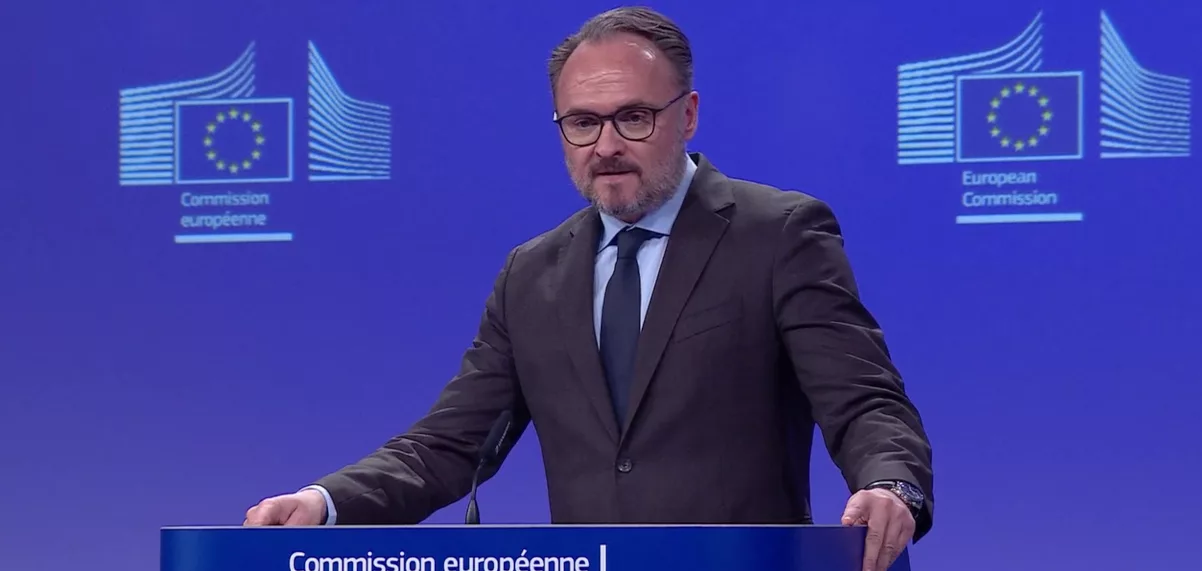
Europe is facing a serious crisis that will last months and could stretch into years, the EU’s Energy Commissioner has warned.
The European Commission has today unveiled a raft of new measures which it says are designed to try to protect households and businesses from price shocks and to be better prepared in light of the war in the Middle East.
The plans include allowing member states, including Ireland, to use public money more flexibly without breaking EU state aid rules, and the setting up of a Fuel Observatory to track EU production and stock levels of jet fuel.
“This is not a short-term, small increase in prices. This is a crisis that is probably as serious as the 1973 and the 2022 crisis combined”, said European Commissioner for Energy and Housing, Dan Jørgensen.
“And this means that we are looking into some very difficult months or maybe even years, depending, of course, on the development in the Middle East. But even in a best-case scenario, it’s still bad.
If we imagine that there is a peace tomorrow, it will still take, for instance, Qatar probably two years, maybe even more, to rebuild their gas production and transportation infrastructure. So this means that the world market LNG prices will not stabilise or even fall as was expected in the next couple of years.
For oil, it’s a little bit different. Probably, we expect the production capacity to be able to be increased quite fast again, even though infrastructure has also been ruined here. But it’ll still be between two to four weeks. And then, of course, there’s the time that it takes to sail the products to Europe.
So even a best-case scenario is a pretty bad scenario for the next months to come, and we will have effects for years.
A worst-case scenario can look in many different ways, of course, depending on the development. But it’s clear that then we are talking very far-reaching and widespread consequences for our economy as a whole.”
The European Commission said this was why they were putting in place measures to allow member states to act.
But there is criticism that most of the EU measures are voluntary and do not come with any new cash.
Five EU member states – Germany, Italy, Spain, Portugal and Austria – have been pushing for a tax on windfall profits of energy companies.
That would allow governments to cream off cash with the money used to damped prices.
But the European Commission has not included that for consideration.
Dan Jørgensen himself has reportedly previously hinted that consumers and businesses could help by swapping cars for public transport and taking fewer international flights.
But these suggestions are also not in the European Commission’s proposals today.
The International Energy Agency (IEA) has estimated that Europe will run out of jet fuel within five or six weeks.
The EU insists that there is no current security of supply issue.
An EU official said although Europe imports 70 percent of its jet fuel supply, only around 20 percent is from supplies that come through the Strait of Hormuz.
But Dan Jørgensen said the IEA’s warning needed to be taken seriously.
“Even though we’re not there yet, we can indeed end up in a situation where this will cause a real problem to us.”
He added:
“We are very much aware that our economies depend, of course, on the ability for us to fly. A lot of people are going on holiday this summer. A lot of cities and regions and member states are dependent on tourism.”
Given all the concerns, Commissioner Jørgensen said, the EU was taking action.
“This is why we are extremely eager to try and set in place policies that not only help us target and address the present price crisis, but also prevent that we will have an actual security of supply crisis in the future.”