
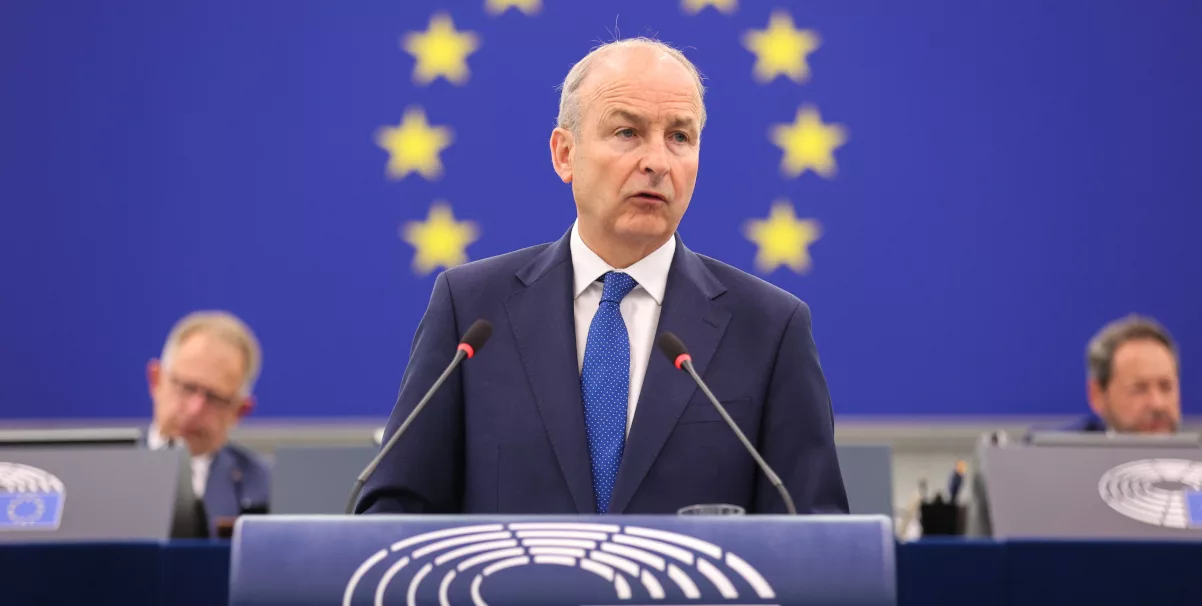
Taoiseach Micheál Martin’s speech in full to the European Parliament in Strasbourg to mark the start of Ireland’s presidency of the Council of the European Union on Tuesday 7 July 2026.
[Speaking in Irish]
“President Metsola, members of the European Parliament, guests, ladies and gentlemen.
I am delighted to be back in Strasbourg – at the very heart of Europe- to address this Parliament, which gives a voice to 450 million of our fellow citizens of Europe.
We hope to be working closely with the members of this parliament during the next six months,. And what we need is we need a major effort of cooperation so that the Irish presidency works optimally.
The motto of the European Union is ‘united in diversity’ and this highlights the rich network of cultures, languages and histories that our union is based on. And how we rely on each other and increase our strength by doing that.
I am here as a representative of the 8th Irish Presidency, to tell you that we respect your role and we respect the specific insight that you have.
The are committed to working with this Parliament in a constructive spirit and in mutual respect so as to do a good job.
I am here to ask for your help. We can do it if we work together.
The 2026 Irish presidency, will be the first since the Irish language became a full working language of the European Union in January 2022.
Madam President, I am an honor to present the policy programme of the Irish Presidency of the Council to Parliament today.
And we have a saying in the Irish language, “Tús maith leath na hoibre” – a good start is half the work.
[Continuing in English]
We have prepared extensively for taking on our responsibilities.
Irish Ministers and officials have had countless discussions with counterparts across capitals, in Brussels, and with this Parliament here in Strasbourg.
We have sought to listen and to understand.
We are ready to get things done.
Our starting position is rooted in the excellent work of the Cyprus Presidency, who have guided the agenda of the Council very effectively through the first half of this year.
I am determined that we will pass the torch forward in similarly good shape to our friends in Lithuania at the start of 2027.
With Greece, we are both part of a proud trio of Presidencies that stretches from our rugged Atlantic shores to the Baltic Sea, and on to the Mediterranean.
Nations each located at the edges of Europe yet determined to be at its heart.
Our shared Union
Madam President,
On each occasion Ireland has held the Presidency we have worked tirelessly to make a positive difference to this unique Union.
While the rotating Presidency was established soon after the Treaty of Rome, the broader and more permanent Council structure was actually established during Ireland’s first Presidency in 1975.
The idea then was, as it remains today, to ensure that members work more actively and systematically with each other and with the other institutions.
Time and again we have seen that when we work together Europe can achieve incredible things.
When Ireland joined the then European Economic Community the debate was centred on whether we were just too poor to participate – with opponents claiming that our economy and culture would rapidly disappear.
The Irish people decided to put their faith in a shared European history – they embraced the idea that in the modern world we can only secure our sovereignty as states by working with others in strong, rules-bound and permanent cooperation.
They rejected the negative and destructive visions of a Europe of permanent national jealousies and competition – of permanent insecurities and falling international influence.
Since then, we have experienced an economic transformation and growing cultural confidence.
Our membership has been an irreplaceable foundation for securing our success and sovereignty.
We have also achieved historic progress in overcoming a history of sectarian conflict – an achievement directly enabled by decades of working together in Europe and seeing the values which we share.
In particular, Madam President, I would like once again to thank you and the Parliament for the solidarity shown to Ireland when the UK decided to leave the European Union.
Because of this solidarity, the impact of that decision has been reduced. Thankfully we have avoided many of the worst impacts seen by the UK itself which the British people themselves increasingly recognise.
A powerful lesson from the lower growth, lower incomes and other negatives of Brexit is how valuable our Union is to all of us, individually and as Member States.
Moves over recent years to rebuild a constructive relationship with the UK have made great progress and are a tribute to all involved.
Madam President,
Working together we have overcome many challenges, including in recent years.
Our Union has acted decisively in the face of the largest global pandemic in a century – saving countless lives.
We have stood resolutely in the face of Russia’s illegal invasion and unrelenting assault on Ukraine.
I commend you, President Metsola, and your colleagues here in the Parliament for your unwavering support for its people – for your consistent, resolute and vital voice in saying that Ukraine is defending basic democratic values and we have a moral and political duty to support its cause.
For our Presidency we turn to an old Irish proverb “Ní neart go cur le chéile” – strength with unity.
Yes, the EU faces challenges.
But we are strong in meeting them together.
Irish Presidency Priorities
The priorities for the Irish Presidency are our assessment of what tasks are most urgent for our Union.
We have highlighted three areas in particular: the competitiveness of Europe’s economy; the need to protect the fundamental values on which our Union is built, at home and abroad; and the security of our citizens.
These three core themes – competitiveness, values and security – are closely interlinked and mutually reinforcing.
Economic prosperity is what enables us to achieve our policy ambitions.
Without a strong economy we will not have security.
And without upholding our values we will not have a Union in which our people can flourish and which we are proud to call home.
Competitiveness
We share the assessment that Europe urgently needs to improve its competitiveness and productivity.
All assessments, including the landmark reports from Mario Draghi and Enrico Letta, show that Europe risks falling behind if we don’t act now.
Competitiveness is a dry word – but it couldn’t be more important to the lives of the people who we serve.
We need to be economically competitive in order to sustain the European way of life.
If we are competitive we can have the prosperity we need to protect the vulnerable in our society. It allows us to provide a robust social safety net
It allows us to live in dignity, with decent housing, with meaningful and productive jobs.
It helps us educate our children and give skills to our workers.
It provides excellence in healthcare allowing Europeans to live longer, healthier lives.
Most fundamentally, it allows us to make the investments to keep our people safe in an increasingly dangerous world, and it supports us in making sustainable choices that can ensure a liveable planet for those who come after us.
The unprecedented heat of recent weeks has shown us how urgent that task is.
In April, the three EU institutions agreed on the One Europe, One Market Roadmap.
This sets the course for our work.
We commit to working closely and cooperatively with Member States, the Parliament and the Commission to make as much progress as we possibly can.
The Single Market is the very foundation of Europe’s economy and prosperity.
The Irish Presidency will work to further eliminate barriers, tackle unnecessary regulatory burdens, and boost internal market trade.
We will drive the digital and climate transition and ensure a level playing field for businesses and communities across the EU.
We will make it easier for businesses to start-up and scale seamlessly across the Union, including through progressing the ‘EU Inc.’ proposal.
I am convinced it is time to take a decisive step forward on the Savings and Investments Union.
Progress has been far too slow.
The Savings and Investment Union can unleash the potential for Europe’s high savings to be used for the benefit of businesses, communities and families in every part of Europe.
Trade is also fundamental to our shared future and prosperity for our citizens. The challenges facing international trade today are formidable and possibly greater than at any time in the last half century. This requires us to be more driven and adaptive than ever before.
Our Presidency will pursue a trade policy agenda with ambition, one that strengthens our trade relationships with reliable global partners.
Relationships which allow us to show the real benefits of trade in terms of good jobs and growing economies.
We will seek to build an EU-US trade and investment relationship that benefits both.
We will work for a close and constructive partnership with the UK – a trusted ally and friend with a strong voice on the international stage.
We will work to strengthen our trade relationships and diversify our markets further afield, deepening trade with important partners such as India, Australia, Malaysia, the Philippines, Thailand and the United Arab Emirates.
High energy prices and global volatility are being felt by families and businesses in every part of our Union – and throughout the world.
We will prioritise work to enhance Europe’s security of supply and the development of sustainable, affordable, and secure energy systems.
To this end we will work constructively with the Parliament to conclude the European Grids Package.
We will support discussions on the benefits and challenges of AI – so that we have a model that is based on European values
To further this, we are convening governments and global stakeholders at an international AI Summit, to focus on how we can best harness AI in support of Europe’s competitiveness.
Values
Our shared values as detailed in the Treaties we all agreed, and based on the UN Charter and the Universal Declaration of Human Rights, are the foundation of our Union.
They are essential to what makes Europe among the best places on earth to be.
Europe believes in respect for human dignity, freedom, democracy, equality, the rule of law, and respect for human rights – including the rights of persons belonging to minorities.
We must defend and vindicate these values – both within Europe and globally – and this parliament has a vital role to play.
During Ireland’s Presidency in 2004, we had the honour of hosting the ‘Day of Welcomes’- celebrating the largest ever accession in the Union’s history.
As long as there are Europeans who seek a secure, democratic and prosperous future – as long as there are millions who see our flag of Blue and Gold as a hope for freedom, we must continue to welcome new members.
Enlargement is a win-win. It brings more Europeans under our umbrella of prosperity and security, and it makes us stronger and richer for the contribution and energy of new members.
During our Presidency, Ireland will work to bring all those looking to join the Union closer to that goal.
We will aim to complete accession negotiations with Montenegro, to make substantial, historic progress with Moldova and Ukraine.
We will advance the countries of the Western Balkans as far as they are ready to go, consistent with our balanced, merit-based approach.
At a time when our democratic values are being systemically questioned, we will promote the rule of law across member states and candidate countries alike.
Our Presidency will also provide a platform for strategic discussions on the future of development cooperation and the enduring challenge of global poverty.
We will continue to support EU efforts toward stability in Lebanon, Syria, and the wider Gulf region.
Our Presidency will also promote active diplomatic engagement to support lasting peace and security in the Middle East, reaffirming the EU’s long-standing commitment to a two-State solution.
The humanitarian situation in Gaza remains dire. The situation in the West Bank is deteriorating. The behaviour of the Netanyahu government is increasingly extreme.
There are no democratic or humanitarian values which are flexible enough to justify the scale of death, destruction and displacement we have seen.
It is a cause of deep and justified sadness and anger to many that Europe has not done enough to put pressure on Israel in the light of its egregious actions.
I fully respect and understand that this is a difficult topic for many countries and is challenging many long-established connections and policies.
But we simply must do more.
Security
The need for measures to enhance European security and to build our resilience has never been more evident.
We will continue to offer unwavering support to Ukraine, whose people have shown such courage and determination in defending their country. They deserve a just and lasting peace.
Political, financial, military and humanitarian support for Ukraine must be coupled with ever-increasing pressure on Russia so that its cruel and morally indefensible war can no longer be sustained.
We will work to agree tighter and stronger sanctions.
Europe must also invest in all dimensions of its own security and rapidly develop its defence capabilities.
We will actively take forward work on the proposed new European Security Strategy to ensure the Union can respond dynamically to today’s geostrategic challenges.
We will not be safe unless we address critical capability gaps. We will support deep collaboration to build European resilience, particularly in the face of sophisticated hybrid threats, and to advance our maritime and cyber security.
Multiannual Financial Framework
To achieve these goals, we need a budget that can match our ambitions.
One of our Union’s greatest weaknesses is that we place such high demands on it but are unwilling to fund it appropriately.
We have too often allowed ourselves to fall into a zero-sum approach which seeks to take funding from successful programmes in order to provide for urgent ones.
In looking forward to the next budget, there are constraints which are unlikely to disappear, but we certainly have the obligation to show both ambition and urgency.
We are committed to doing all we can to achieve agreement on our financial framework for the period beyond 2028.
We believe that agreement in the Council can be achieved by the end of this year.
It obviously won’t be easy.
There are very different views around the table, both about how we raise our money, and how we spend it.
We will work as an honest broker to try to narrow gaps and to bring people together.
Building on the excellent work of the Cyprus Presidency, we will set out our thinking in a new negotiating box in the Autumn.
Conclusion
President Metsola, to support our policy agenda, we will host an extensive programme of Presidency meetings – more than 270 events – in locations across Ireland.
We do so conscious of how important it is to engage our citizens in our conversations around the EU.
Telling the story of the EU – and why it remains so vitally important to peace, prosperity and security across our continent – is something we attach great importance to.
We look forward to welcoming colleagues from EU institutions and from across Europe to counties across Ireland.
This includes the meeting of the European Political Community and the informal meeting of the European Council in November in Dublin.
We will host this and every meeting of the Presidency in a spirit of cooperation and a commitment to the great ideals which built our Union.
At a moment where so many are promoting division and a return to a failed model of competition between nations, we will clearly and without any reservation speak for the vital necessity of the democratic and humanitarian ideals of Europe.
For its commitment to progress through cooperation – for its strengthening of national cultures through the security of shared interests.
For me a visit to this chamber always brings to mind one of the most distinguished former MEPs and unquestionably one of the greatest figures in modern Irish history, John Hume.
He remains the only MEP to have been awarded the Nobel Peace Prize while serving in the Parliament.
While he represented Northern Ireland, he spoke for the vast majority on our island who wanted a future free of the sectarian violence inflicted on our society by an unaccountable few.
He was not just our visionary of peace, he was a passionate advocate for peace and prosperity through a shared European future.
Just as the great generation which secured our independence brought us to membership of the European Union, John Hume directed us to its values and the opportunities for reconciliation and breaking the historic cycle of distrust and conflict.
So for 25 years he both led the largest nationalist party in Northern Ireland, he came here as an MEP to work with others to define and built a new future for his community, our island and the people of Europe.
Just outside this hemicycle, there is a bust of John, as a fitting memorial to how important the Parliament’s work can be.
He came from the city of Derry on the very North-West edge of Northern Ireland. His community experienced great poverty, division and conflict.
In his Nobel lecture, John spoke about how inspired he was by this place and the European Union.
He spoke of his first visit to Strasbourg and standing with a sense of wonder in the middle of the bridge from Strasbourg to Kehl.
He was moved by the almost inconceivable success of leaving behind a tradition of savage conflict between nations and replacing it with a new era of cooperation.
John was both a visionary and an immensely practical man. He saw obstacles, but he also saw how to move them out of the way.
To honour his legacy, later this year we will be establishing and funding a new annual prize in his name. This will be awarded to a European who has contributed to the values which John advocated for and to the further development of our Union.
John had the vision to see the narrative of Ireland’s path to peace and prosperity in the wider narrative of Europe. As he saw it, the road to lasting progress is built in shedding our sweat together, rather than our blood.
It is a vision that is as relevant today, as when he graced this Parliamentary chamber.
Thank you again, President Metsola, for your welcome here today. On behalf of the Irish Presidency I look forward to working with you and the Parliament across the next six months.
We will approach this with a spirit of cooperation and ambition to ensure that our shared European Union delivers for the people we all serve.
Go raibh míle maith agaibh [Thank you very much.]”