
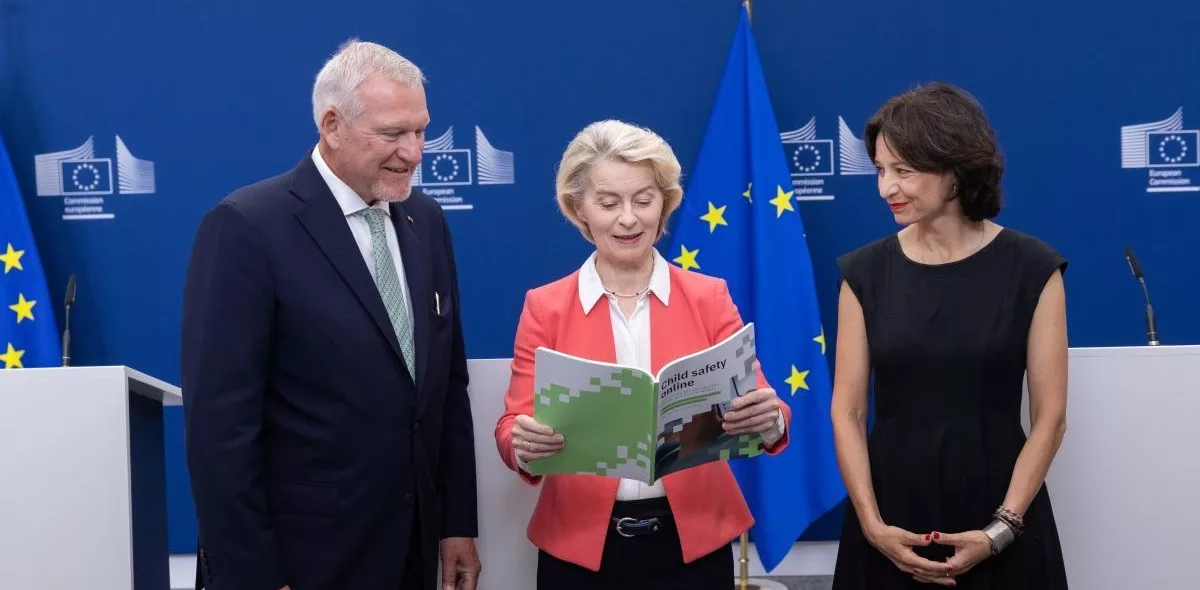
Experts have advised the EU to put in place a Europe-wide ban on children accessing social media and other websites that may contain inappropriate content.
The President of the European Commission, Ursula von der Leyen, commissioned the Special Panel on Child Safety Online to consider the best way forward in the wake of growing concerns about websites and apps.
In their report, the panel recommends a “phased approach” with a complete ban on phones and computers for toddlers, limited, supervised access to social media for under 13 year olds and “gradual access” for older teenagers.
Responding to the report, von der Leyen said it was a “very convincing” approach.
“The two co-chairs are recommending a harmonised EU-wide delay to ‘Social Media plus’ under the age of 13,” she explained.
“So if we start with the youngest, toddlers: No screens at all.
Then children under the age of 13: Access to social media only under the supervision of parents, caregivers, teachers, and time limited.
And then from the age of 13 on, and that’s very important, there’s a gradual access, depending on the proof given by the platforms that they are age appropriate and safe for teenager. So indeed, the responsibility of the platforms to prove to us that they are safe and age appropriate.
Only this opens the door beyond the age of 13 for a teenager to access social media, and I personally find this approach very convincing.”
Whilst signaling a hard line against social media firms and websites, von der Leyen has also left a window open to work with tech companies.
“The platforms were the architects of these systems, now they must prove that their services do no harm,” she warned.
The European Commission has already threatened Facebook, Instagram and TikTok with heavy fines for what the EU believes is “addictive design” apps.
Now they have a matter of months to convince the EU that their systems can be tailored to different age groups and ensure they are safe for children.
“We will carefully review this report and the recommendations. And present a proposal after the summer,” von der Leyen said.
According to polling commissioned by the European Commission, online harm is a huge concern to parents and guardians, but there are different views on how to deal with it.
“A large majority of Europeans want the EU to do more to protect children from the risks online,” according to the European Commission’s interpretation of the polll results.
“Nearly two in three Europeans (63 percent) want EU rules restricting children’s access to social media by age, whether through an outright ban below a certain threshold (36 percent) or delayed access (27 percent). 15 percent favour reinforcing law enforcement resources, while 13 percent prefer leaving oversight to parents and schools without further EU intervention.”
Many European countries, including Ireland, have either committed, or are already pursuing, social media bans for children.
Spain is one of the most advanced down this track.
The EU has also created the backend tech for an age verification app that could be developed to lock phones for adult-only use.
The Irish government’s MyGovID app is being built around this tech.
At the moment, its principle objective is to create a safe login for public services. But EU sources say it could also be tailored for age verification.
Ireland currently holds the rotating presidency of the Council of the European Union.
Responding to the publication of the report from the Special Panel on Child Safety Online, a spokesperson for the presidency said:
“Strengthening online safety is a priority for the Irish Presidency and we look forward to the [European] Commission’s response to the report.
In September we will host a Conference on Online Safety for Children and Young People in Dublin. We are committed to taking forward work swiftly on the protection of minors online.”