
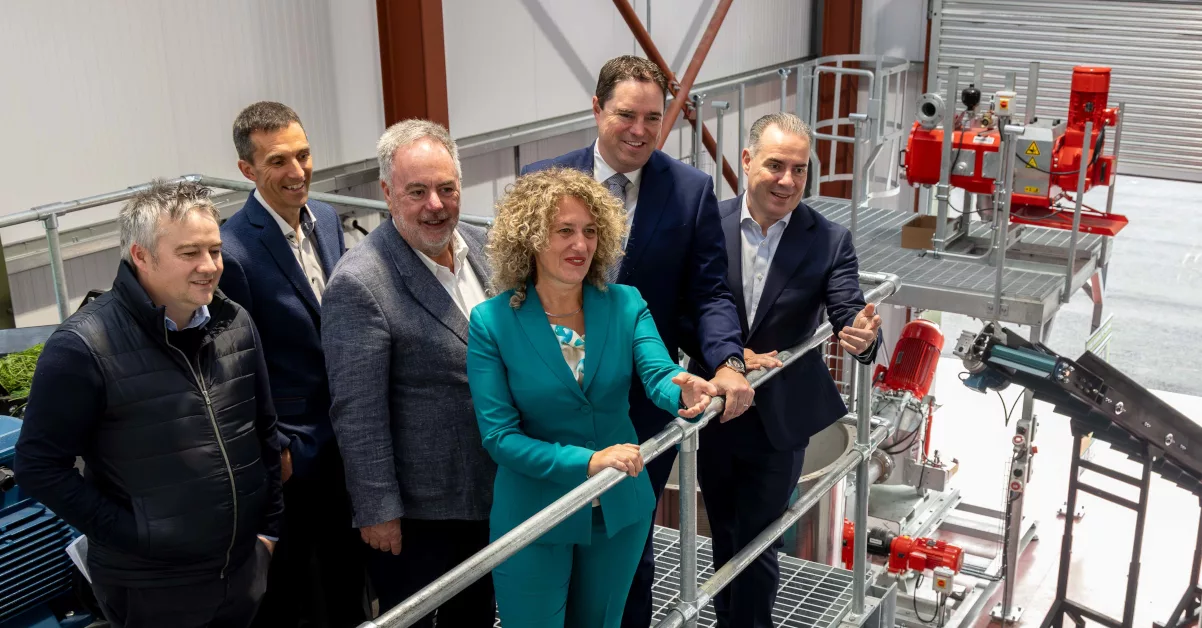
Ireland’s first on-farm demonstration plant combining grass biorefining with anaerobic digestion has officially opened at Shinagh Estates in County Cork.
Biorefining is the process of harvesting fresh grass and converting it into bio-based products such as high-protein animal feed, organic fertilisers, and green energy.
The €3 million facility, launched by Minister for Agriculture, Food and the Marine, Martin Heydon, is designed to demonstrate how Ireland’s abundant grass resources can be used to produce more than livestock feed.
The project forms part of the Farm Zero C initiative at the dairy farm and aims to explore new commercial opportunities for farmers while supporting Ireland’s climate and sustainability goals.
Ireland has some of the world’s highest grass yields, thanks to its temperate climate, fertile soils and established grassland-management expertise. At the moment grass is used mainly as feed for livestock.
The new plant will test whether the same raw material can be processed into a wider range of products, including high-protein animal feed, fibre for packaging and feed, renewable energy and for use as a fertiliser.
The green-biorefining process separates fresh grass into a fibre-rich press cake and a liquid stream. The press cake can be used for livestock feed, while protein and other biobased ingredients can be recovered from the liquid.
Residual material can then be sent for anaerobic digestion, producing renewable energy and nutrient-rich material with potential applications as a fertiliser, subject to regulatory and quality requirements.
The government points out that the Cork facility is a test site rather than a full commercial operation.
Researchers and industry partners will assess the product quality and environmental performance. They will also consider the cost and financial viability of rolling out similar facilities in other parts of Ireland.
The plant’s development has been backed with €7 million in EU funding. The project will examine whether ‘farmer-centred’ biorefineries could be replicated in other European grassland regions.
The initiative aligns with priorities set out in the EU’s new Protein Action Plan and EU Livestock Strategy. Both emphasise the need to reduce Europe’s dependence on imported protein, strengthen strategic autonomy and make better use of domestic resources.
Supporters argue that grass biorefining could make rural economies more resilient by creating additional revenue streams.
Minister of State Noel Grealish said the Government had invested more than €40 million in bioeconomy research over the past decade.
Further development will come through the €3 million Grass4Value project, which will investigate the use of grass and legumes for feed, food applications, renewable energy and biobased fertilisers.
The Cork facility brings together Munster Technological University, University College Dublin, Carbery Group, Shinagh Estates, BiOrbic Research Ireland and the University of Galway.