
It has no smell, colour or taste, but can be lethal if there is a build up in your home. Radon is a naturally occurring gas which forms as uranium in rocks and soil decays.
It can seep through soil and cracks into the floors of homes and offices.
Some of the highest radon concentrations found anywhere in Europe have been found in homes and workplaces in Ireland, according to the Health Protection Surveillance Centre.
Latest polling commissioned by the Environmental Protection Agency (EPA) has found that awareness about radon has fallen over the past five years from 82 percent in 2020 to 71 percent more recently.
“The EPA is concerned to see a decline in radon awareness, and the continued reluctance among householders to test their homes,” said Patrick Byrne, the EPA’s Director of the Office of Radiation Protection and Environmental Monitoring.
“We found that many believe that their property is not affected. This is particularly worrying given that radon is our largest source of radiation exposure and a leading cause of lung cancer.”
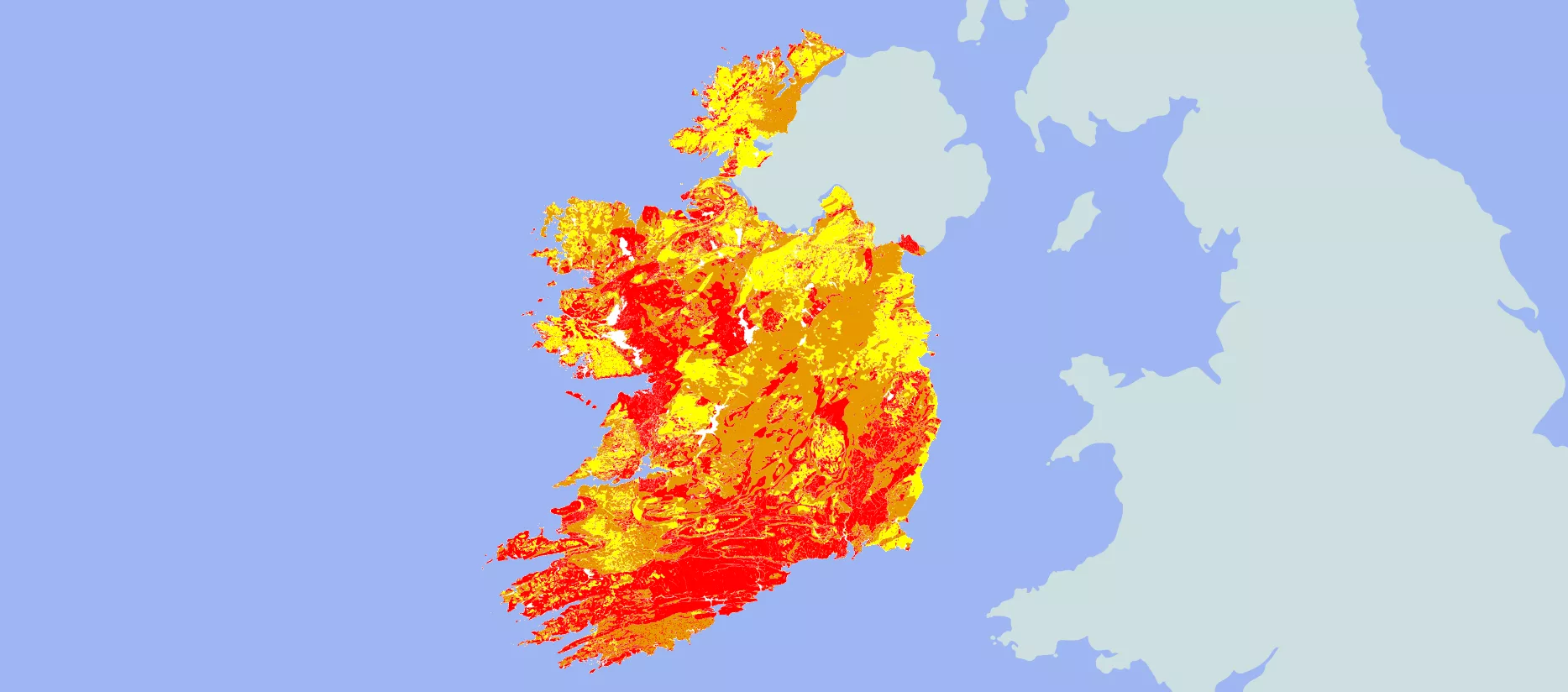
The European Commission’s Joint Research Centre has a dedicated centre for mapping naturally occurring radiation. It shows widespread, but largely milder concentrations of radon right across Ireland.
However, the EPA has used more detailed data, including indoor measurements, to make a “prediction of the number of the houses in any one area that are likely to have high radon levels”.
Areas in red (see headline image) are classed as “most at risk from radon”. The EPA says that means “about one in five homes in the area is likely to have high radon levels.”
“Testing for radon in your home is simple and we urge all households to take this step to protect themselves and their families,” said Patrick Byrne.
“It costs about €50 and the EPA website has a list of companies that supply the monitors. Reducing you and your family’s exposure to this harmful gas can be achieved using simple and effective methods.”
It is also possible to borrow a radon monitor for a few weeks through a lending scheme at libraries in Carlow, Cavan, Clare, Cork City and County, Donegal, Fingal, Galway City and County, Kilkenny, Longford, Louth, Meath, Mayo, Offaly, Roscommon, Sligo, Tipperary, Waterford, Westmeath, Wexford, Wicklow.
What if I discover high levels in my home or workplace?
The Health Protection Surveillance Centre says: “It is recommended that householders should carry out radon remediation work when the radon level is 200 Bq/m3. The action level for workplaces is higher, at 400 Bq/m3, as people generally spend more time at home than at work. So testing is an important way to protect yourself and your family.”
If high levels are discovered, remedial work may be necessary to close up any gaps where gas can get into the building.
The National Radon Control Strategy which is led by the Department of the Climate, Energy and the Environment brings together government departments and state agencies to take action to reduce radon risk.
The EPA says that it will use the findings of the survey to “strengthen its awareness work” to encourage more testing and remediation to reduce radon risk to people’s health.