

Greenhouse gas emissions across the European Union have fallen by 17 percent over ten years, but for Ireland they have barely changed, according to new data from the EU’s statistics agency, Eurostat.
Between 2015 and 2025, greenhouse gas emissions fell across most EU member states as governments worked to meet environmental targets.
Ireland emitted the equivalent of 73.1 million tonnes of carbon dioxide in 2015. By 2025, emissions had barely changed at 72.8 million tonnes.
Over the decade, Estonia, Finland and Germany have cut their emissions by more than a quarter.
But Ireland is not the worst. Whilst not making any substantial improvement, at least emissions have not increased.
Romania, Lithuania, Cyprus and Malta have all seen emissions increase as their economies have grown.
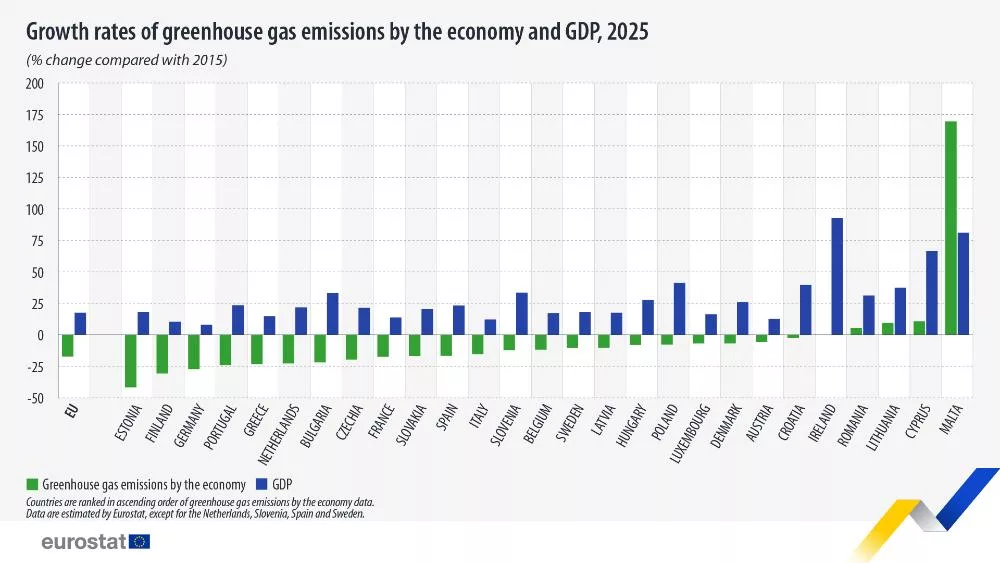
Across the EU, emissions were down 17 percent, whilst the European Union’s economy grew by 17 percent. That has given rise to a hope of breaking the link between prosperity and pollution.
On that measure, Ireland is the biggest success story. The Irish economy has grown, in GDP terms, by more than any other over the past ten years whilst emissions have not.
But the stats hide a number of realities.
Last month, the Climate Change Advisory Council (CCAC) warned that Ireland is “unnecessarily dependent” on imported fossil fuels.
When Ireland imports electricity that has been generated using fossil fuels in other European countries, there are still emissions, they just don’t appear on Ireland’s total.