
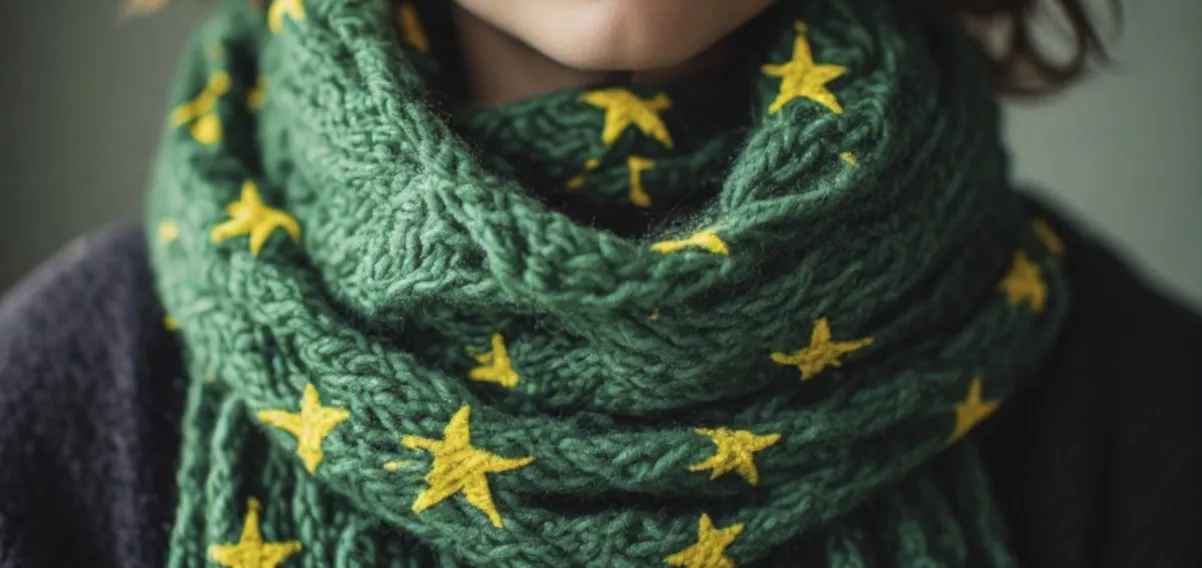
The Irish government is planning to gift woollen scarves to EU ministers and ambassadors later this year, government documents have revealed.
The contract for 4,500 scarves will cost Irish taxpayers €135,000 meaning the government is prepared to pay €30 per scarf.
Ireland will hold the Presidency of the Council of the European Union from 1 July to 31 December 2026.
Over six months, Irish ministers and officials will chair hundreds of meetings around Ireland and in EU buildings in Brussels, Strasbourg and Luxembourg.
The government sees the presidency as an opportunity to showcase Ireland at its best. Dignitaries are expected to be greeted with sights and ceremonies. And it is now apparent that ambassadors will receive custom made gifts for the occasion.
A tender published by the Department of Foreign Affairs and Trade (DFAT) has invited bids from textile manufacturers to produce around 4,500 woollen scarves “with a distinctive and uniquely Irish artistic character.”
“The provision of mementos is an opportunity to strengthen goodwill between colleagues and to promote domestic craftsmanship internationally, promoting the cultural identity of the host country and strengthening economic and cultural links,” the department said.
Exchanging goods between ambassadors and also ministers is a long held practice. But woollen scarves is an unusual choice.
It is likely a slightly tongue-in-cheek reference to Ireland’s weather.
Ireland is taking over the presidency from Cyprus. The Mediterranean island has been able to show off its blue skies and sunshine for much of the past five months.
Irish officials have been working on the preparations for the presidency for more than a year. And Minister of State for European Affairs, Thomas Byrne TD, said there was pressure to do a good job.
“The task ahead of us in taking on the EU Presidency is very significant, and I know from the programme of visits that I have been undertaking to EU and European capitals in recent months, that expectations of the Irish Presidency are very high.
Across the Government, we will work hard to meet those expectations and deliver a successful EU Presidency that enhances Ireland’s international standing and influence and delivers for Europe and its people,” he said.
The country in the presidency chair is expected to play the role of “honest broker” in negotiations, according to the European Council.
But it is also an influential position because the presidency can push and promote areas of legislation it sees as a priority.
Ireland’s Minister for Foreign Affairs and Trade, Helen McEntee TD said she was in the process of “finalising our policy priorities for the Presidency, informed by extensive engagement with our European partners and stakeholder groups here in Ireland.”
The presidency comes with considerably costs. Aside from €135,000 for scarves, the government will spend more than €10 million on transport including buses and chauffeur driven cars, €13 million on building work and close to €1 million on multimedia services.
The government has also ordered Ireland-branded tote bags, notebooks and pens.
The tender for woollen scarves was first spotted by journalist, Ketrin Jochecová. At the time of writing the tender deadline has passed and is currently under “evaluation”.
The department said “important considerations will include security; cost effectiveness and value for money; sustainability; environmental impact; and community benefit.”
The scarf shown was generated by AI to illustrate this article. The actual design has not been revealled.
The tender in full reads:
“During the Presidency, an extensive and wide-ranging programme of meetings, events and conferences will be held in Ireland. The programme will include official-level meetings, as well as meetings with senior political-level attendees such as informal Council of Ministers meetings. Events will be organised by a wide range of Government departments and official bodies. In addition, Irish Ministers and officials will chair multiple meetings of over 170 EU working parties and other high-level meetings in Brussels and Luxembourg each involving delegations from all EU Member States. The Department of Foreign Affairs and Trade (DFAT) has responsibility for the procurement of a range of goods and services associated with supporting a co-ordinated and cost-effective cross-Government approach to delivery of this programme of events. In the procurement of goods and services for the Presidency programme, important considerations will include security; cost effectiveness and value-for-money; sustainability; environmental impact; and community benefit. It is customary for the Member State holding the Presidency of the Council of the European Union to provide mementos for Heads of Delegation at certain high-level Presidency meetings. The provision of mementos is an opportunity to strengthen goodwill between colleagues and to promote domestic craftsmanship internationally, promoting the cultural identity of the host country and strengthening economic and cultural links. Accordingly, the Contracting Authority is seeking the supply and delivery of approximately 4,500 woollen scarves, with a distinctive and uniquely Irish artistic character.”