
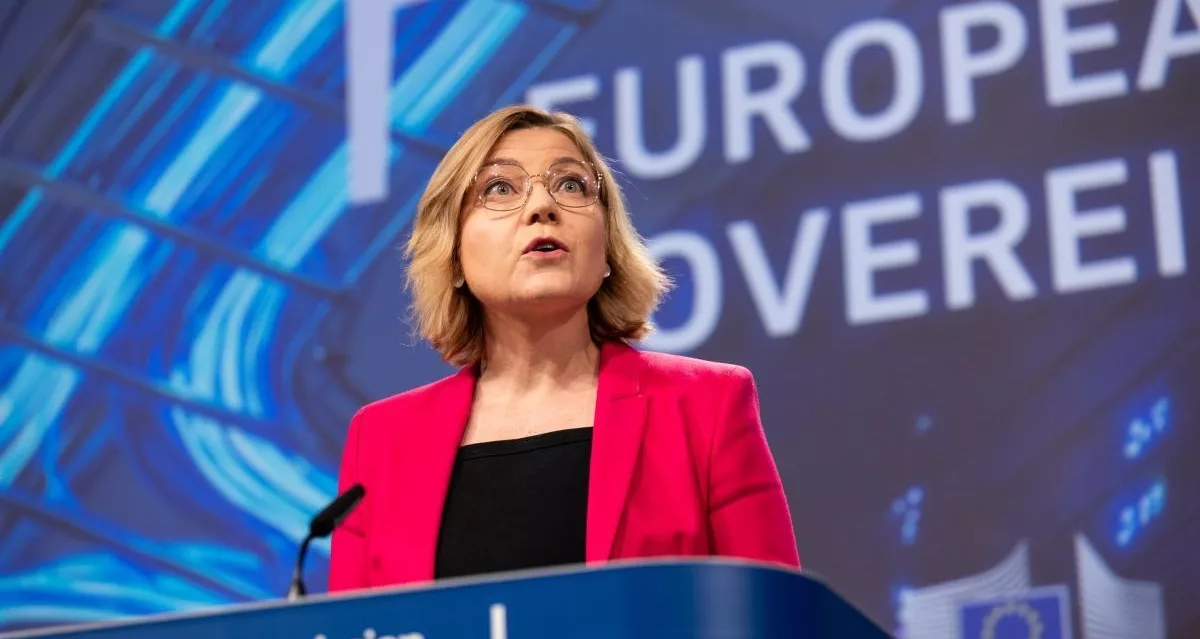
The EU should end its dependence on the US and China for technology, the European Commission has announced.
Under the European Commission proposals, Europe will try to get ahead on AI, push for the building of more data centres and champion home-grown semiconductor firms.
The European Commission will also draw up a list of critical infrastructure that should be powered by European technology.
Around 80 percent of digital products, services and infrastructure is run by non-EU companies, mainly from the US and China, according to the European Commission’s Executive Vice-President, Henna Virkkunen.
“We cannot afford to depend on others for the technologies that keep our hospitals running, our energy grids stable and our services secure,” European Commission President, Ursula von der Leyen, said
“This is about protecting our citizens, defending our interests and making our own choices. Europe has the talent, the research excellence, the industrial base and the Single Market. Together, we must turn these strengths into technological sovereignty.”
The European Commission’s “Tech Sovereignty Package” contains several measures including two new proposed regulations covering the developments on AI, cloud technology and open source software.
There is also a pledge to triple Europe’s “sustainable” data centre capacity over the next five to seven years.
Reducing Foreign Dependency
The European Commission insisted that its new strategy is not a move towards isolationism.
“Technological sovereignty does not mean protectionism. Europe remains grounded in openness, partnership, and fair competition,” Virkkunen said.
Instead, she said the goal is to ensure Europe can make its own choices without being beholden to single dominant suppliers or third countries.
The proposals
The package of measures includes four “crucial elements” designed to transform the European digital landscape:
Chips Act 2.0: A successor to the original act, focusing on capturing the AI-related semiconductor market, which is expected to comprise 70% of the total market by 2030.
Cloud and AI Development Act (CADA): Focused on research, sustainable capacity building, and ensuring “critical sensitive data is stored in Europe” through a new four-level sovereignty framework.
Open Source Strategy: Aiming to harness the power of Europe’s three million open-source contributors to give the EU more control over its digital future.
Digitalisation of Energy: A strategic roadmap to manage the energy demands of this digital transition.
The Investment Gap
Acknowledging that these ambitions require “massive investments,” Virkkunen warned that Europe is currently falling behind global competitors who are “pouring massive amounts of cash” into the sector.
The Commission is now launching consultations to build a “European equity capacity at scale,” arguing that while public funding is a start, “taxpayers cannot foot this bill alone”. The goal is to ensure European startups have the private capital needed to grow into “global champions” without leaving the continent.
As Ireland continues to balance its role as a tech leader with the pressures on its national grid, the EU’s commitment to “sustainable” capacity building will be a focal point for domestic policy in the coming years.