
Not enough new homes are being built to meet demand, the Economic and Social Research Institute (ESRI) has warned.
In its latest economic update, the ESRI is positive about the state of the economy which it says, in real terms, continues to grow.
But housing continues to be a concern.
The government has previously set a target of constructing 50,000 homes per year, growing to 60,000 per year by 2030.
The ESRI now estimates 38,500 new homes will be constructed this year rising to just under 40,500 for 2027.
“The absence of sustained upward momentum in planning permission figures presents a challenge to raising output substantially and meeting housing targets in the medium term,” researchers warn.
The institute uses data on “level of planning permissions, commencements and completions” to estimate the number of homes being built.
The Central Bank of Ireland is marginally more optimistic.
Last week, it estimated that “housing completion forecasts remain unchanged at 40,000, 43,000 and 46,000 for 2026, 2027 and 2028.”
All estimates fall short of the government’s target.
The ESRI said it was also watching the impact that the wider economy – and especially the war in the Middle East – has on housing.
Prices of oil-based products used in construction like bitumen and asphalt have risen by 10 percent, but other key materials like insulation, concrete and bricks have not, so far, increased significantly.
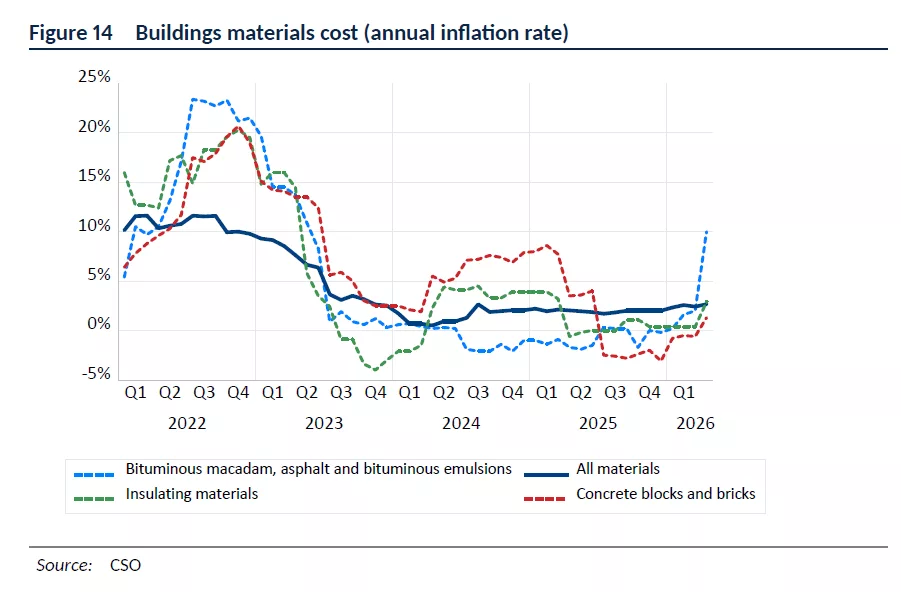
However, the institute advises the government remains vigilant on building costs.
The ESRI pointed to a recent study that calculated that construction dropped 0.84 percent for every one percent increase in construction costs.
The ESRI’s Quarterly Economic Commentary is a keenly watched analysis on the state of the Irish economy.
“While the headline public finances figures look strong, we remain concerned about potential vulnerabilities,” said co-author, Alan Barrett of the ESRI.
The European Commission is concerned about rising housing prices across the EU and is due to come out with proposals for a new Affordable Housing Act next month.