
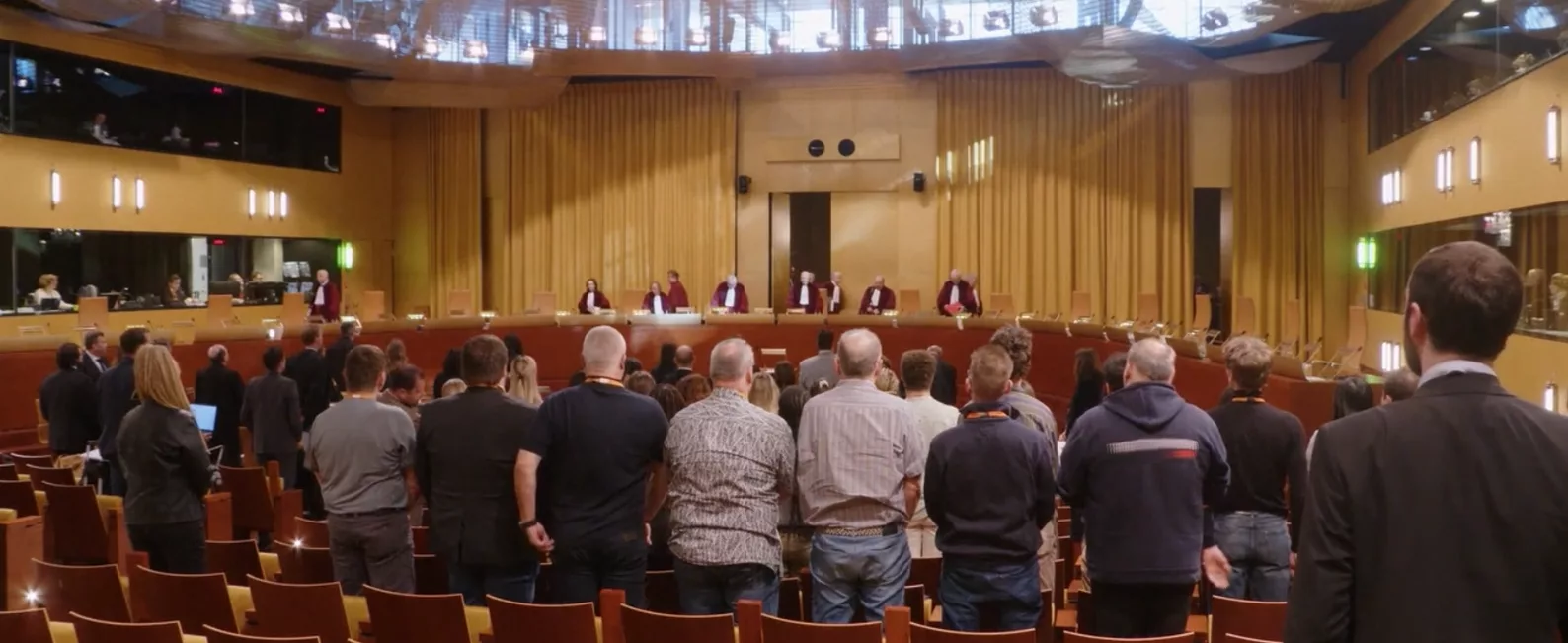
The European Court of Justice has ruled on the definition of ‘pastiche’ in a copyright dispute that could have wider implications.
For more than 20 years, the German band Kraftwerk has been in dispute with the composers of the 1997 track ‘Nur mir’ over the repeated use of two seconds of rhythm sequence from Kraftwerk’s 1977 hit, ‘Metall auf Metall’.
Under a German law that entered into force in 2021, the term ‘pastiche’ allowed the use of copyrighted work “for the purpose of caricature, parody or pastiche, the reproduction, distribution and communication to the public of a published work.”
But when is something a pastiche tribute and when is downright plagiarism?
This morning, the European Court of Justice ruled that pastiche can be defined as:
“Creations which evoke one or more existing works, while being noticeably different from them, and which use, including by means of sampling, some of those works’ characteristic elements protected by copyright.”
That legal definition will now be applied to all works of art in Europe.
The concept of pastiche has existed for hundreds of years. Painters and musicians would pay homage to other artists by including an element in their works.
“It is sufficient that the ‘pastiche’ nature be recognisable for a person who is familiar with the existing work from which the elements have been borrowed”, the European Court of Justice said in its ruling this morning.
The Court said that the interpretation of ‘pastiche’ “ensures a fair balance between the protection of the freedom of the arts and copyright protection, as well as legal certainty.”
The Kraftwerk case will now return to the German Federal Court of Justice to rule on the dispute.
The Federal Court said that the song ‘Nur mir’ “artistically engages with the rhythm sequence taken from the track ‘Metall auf Metall’, which is in a different music genre, while being, despite the reduction in tempo and the metric modulation, recognisable as alluding to the original.”