
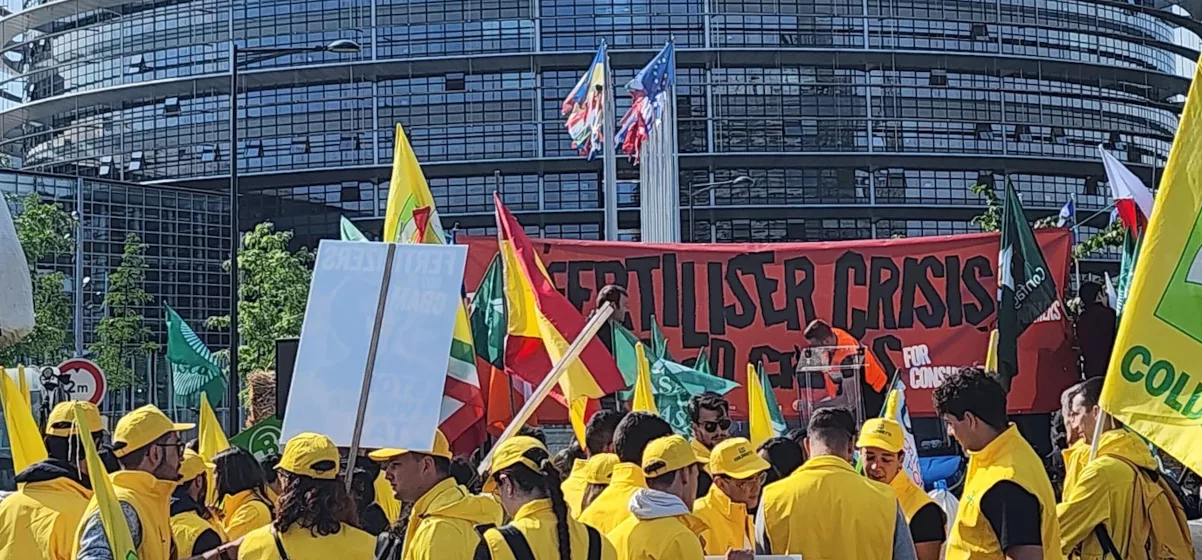
The European Commission has announced new support for farmers struggling to pay for fertilisers.
“Fertilisers are not only an agriculture issue. It is a question of Europe’s food resilience,” said European Commissioner for Agriculture, Christophe Hansen.
The price of some fertilisers has risen by as much as 70 percent over the past two years and the situation has been exacerbated by the war in the Middle East.
The Gulf region accounts for approximately 35 percent of global nitrogen fertiliser exports. Gas from the Middle East is also used to make more fertiliser in Europe.
The EU was quick to reassure people that farmers have enough supplies for the current growing season, but with summer approaching, the European Commission is aware that farmers are starting to make plans for next year.
“The European market remains supplied for this agriculture season, and EU food security is not at risk. The concerns, though, are the affordability, the predictability, and the resilience. And farmers, we know, need predictability when they make decisions in this summer on their next planting season,” said the European Commissioner for Agriculture, Christophe Hansen.
Speaking in the European Parliament this afternoon, he announced there would be a “substantial” package of short term aid for farmers.
He would not be drawn on how much money. The EU’s Agricultural Reserve currently has an annual budget of €450 million, with approximately €200 million still available from the current allocation, according to EU officials.
In addition to the “targeted, exceptional support”, there will also be more flexible terms applied to the Common Agricultural Policy (CAP).
“We will propose a targeted CAP package, including also a new liquidity scheme, flexibility for advanced payments, and support for fertilisation efficiency so that Member States can use all funds available under their CAP strategic plans,” Christophe Hansen said.
In the longer term, he wants to see Europe shift away from fossil fuel based fertilisers so that the reliance of gas from the Middle East will not be an issue in future.
“In the long term, the Commission will address regulatory and market barriers and help create lead markets for bio-based and low-carbon fertilisers while also reinforcing domestic production and improving sustainable nutrient management,” the Commissioner added.
Whilst the Fertiliser Action Plan was announced by Christophe Hansen in the European Parliament, outside on the streets of Strasbourg, farmers were already protesting.
“This plan, unless there is a rapid change in direction, is unlikely to meet the expectations of the European farming community or address the scale of the crisis that has been unfolding since the outbreak of the conflict in Iran,” said European farming union, COPA-COGECA, ahead of the Commission’s announcement.